Categories
Blogging Driving Food Geography Home Nature Travel

Ag Tour

Welcome back to #TravelThursday. Last week I wrote about the middle 3 hours of my 9-hour “ag tour” that I went on 4 Thursdays ago – hosted by UF IFAS Extension – which stands for University Of Florida Institute Of Food And Agricultural Sciences. They have Extension offices in all 67 of Florida’s counties. (I’m in Highlands County.)

After our steak lunch at the Avon Park Community Center – we headed west for a very short drive (exactly one mile) to Classic Caladiums. Our group was greeted out front by Clay for a talk about their company – the world’s largest caladium grower. Created in 2000 – they produce about 30 million bulbs annually of about 100 varieties. Clay led us on an extensive tour of their very busy working warehouse. It was very interesting. They have a well-run operation there with about 25 full-time employees and over 100 workers during peak harvest and grading season (October to March).

Our 5TH stop of the day was right across the street from Classic Caladiums at the Barben Blueberry Farm. We stayed on the bus for this stop, and Bobby Barben came on to tell us all about his family’s farm and their long history (4TH-generation / over 100 years) in the citrus business.

Our final stop of the day was 23½ miles away at Lake Istokpoga Park. This stop fulfilled the “Natural Resources” portion of our day-long tour of the region. A young guy led the talk. I think maybe he’s a Highlands County Parks & Recreation employee. His talk was mostly a geology and geography lesson of the County, and most of his facts were accurate. I didn’t really learn much from this segment, as I’ve previously studied it.

We returned back to the Bert J. Harris, Jr. Agricultural Center Highlands County at about 5:10 PM, and our 9-hour tour / 10-hour experience was complete. I enjoyed it all. All 6 stops were places that I had never been to before (aside from driving by). The first two stops before lunch at the citrus farms were the most interesting. Lunch was good. And the first stop after lunch at the caladium warehouse was educational and informative. The last two stops were the least interesting.

TODAY – Thursday March 26TH 2026 – is actually the final UF IFAS Extension “ag tour” of the season, and I am not on it. They are on a tour of 6 different stops – including a steak lunch. I’ll try to get on 1 of the 3 tours next winter season. As for today – I’m returning home from South Florida. I was down there for the first time in nearly 9 months. I’ll write all about it – next – #TravelThursday. Let’s keep traveling together.

All rights reserved (c) 2026 Christopher M. Day, CountUp
Categories
Blogging Driving Food Geography Home Nature Travel

Ag Tour

Welcome back to #TravelThursday. Last week I wrote about the first 2 hours of my 9-hour “ag tour” that I went on 3 Thursdays ago – hosted by UF IFAS Extension – which stands for University Of Florida Institute Of Food And Agricultural Sciences. They have Extension offices in all 67 of Florida’s counties. (I’m in Highlands County.)

After our first stop a few miles east of Fort Meade along U.S. 98 at the Dundee Citrus Growers Association (CGA) Citrus Under Protective Screen (CUPS) farm – we headed east and then south back into Highlands County to the Avon Park area where we would make our next 4 stops.

Our next stop was a citrus grove east of Avon Park. We met 3 members of Biotech Applied Research (BAR) – including Zack Farr (Co-Founder, President, & CEO) and Jeff Williams (Owner of J.W. Harvesting – comprising of about 100 acres of citrus groves).

Jeff’s groves used to be healthy and abundant before greening swept across them in 2013. That’s where BAR comes in. They convert dead citrus (bio-waste) into biochar. What’s biochar ?

Biochar is a soil-focused charcoal made by heating organic material (like wood or agricultural waste) at high temperatures with very little oxygen. The result is a lightweight jet-black material filled with microscopic pores that hold water and nutrients in the root zone, create habitat for beneficial soil microbes, improve long-term soil structure, and stay in the soil for decades. It is not a fertilizer. It does not feed plants directly. Instead – it improves the soil so the nutrients and water you already add work better and last longer.

We all got a free bag of biochar along with an information sheet all about it. (I used some of that information above.) As a non-gardener / non-grower living inside a condo neighborhood – I had no use for it. So – I brought it to the Charles F. Weigle House Museum & Gift Shop earlier this month for one of our Wednesday Morning Socials, and I did a “show-and-tell” on it. I said that whoever wants it can have it, or else I would use it in our front garden of the museum. One of my friends there accepted it. He will use it in his home garden.

After learning all about biochar – we headed into town (Avon Park) to enjoy lunch inside at the Community Center (which I had never been to before). It’s actually located right next door to the Avon Park Historical Society and their Depot Museum – a place that I have visited and written about often.

We enjoyed a plate of steak (grilled outside), scalloped potatoes, veggies, and cookies for dessert. It was pretty good. The steak wasn’t the best quality cut, but it wasn’t bad at all. It was all served on paper plates (doubled-up) with plastic forks and knives, so that was not ideal. I lost part of a prong of my fork, so I had to find it to be careful not to eat it.

Next #TravelThursday – The Ag Tour concludes with caladiums, blueberries, and a geology lesson. Let’s keep traveling together.

All rights reserved (c) 2026 Christopher M. Day, CountUp

Categories
Blogging Bugs Driving Food Geography Home Nature Travel

Ag Tour

Welcome back to #TravelThursday. Last year a couple of my friends at the Sebring Historical Society told me all about an “ag tour” that they went on. It sounded very interesting. They boarded a bus early in the morning, and they went on a guided tour of various agricultural sites around the region. In the middle of it all – a big steak lunch. I was intrigued. Travel & Food together. Two of my favorite pastimes.

The tours are limited to the winter season – January, February, and March – on the last Thursday of each month. They start at 8 AM and end at 5 PM. They are hosted by UF IFAS Extension – which stands for University Of Florida Institute Of Food And Agricultural Sciences. They have Extension offices in all 67 of Florida’s counties. (I’m in Highlands County.)

I didn’t get a chance to sign-up for any of the remaining tours last season (2025), and then I pretty much forgot about them during the “off-season”.

Last month at our Sebring Historical Society board meeting we were discussing an upcoming event when one of our board members pointed out that the date of that event conflicts with an “ag tour”.

Once he said that – bells started ringing in my mind. I went home that night and began looking up the ag tours to get more information on them. One was coming up on the last Thursday of February. I read the itinerary. I was determined to be on it. Less than a week later I actually drove to the Extension Office (for the first time ever) – 10 miles away from home – to sign-up for it and pay for it ($100).

Thursday February 26TH 2026 was the date of the tour, and I arrived back at the Extension office (formally it’s the Bert J. Harris, Jr. Agricultural Center Highlands County). I arrived about 40 minutes before the start of the tour. Apparently – that wasn’t early enough, as there were already several dozen people there before me. I checked-in, I retrieved my big bag of goodies / freebies from the various sponsors of the tour, and I got on the 56-passenger luxury coach.

We departed promptly at 8 AM on a mostly cloudy and chilly morning. We took an unusual route to our first of six stops – perhaps by design. We headed south briefly along U.S. 27 before turning west into Hardee County, and then north into Polk County. It was all two-lane backroads (after U.S. 27) – through the countryside – with farmlands on both sides. Many of the farms didn’t look too good after numerous frosts and freezes. Our UF IFAS hostess narrated and answered questions along the way. She was very knowledgeable and informative.

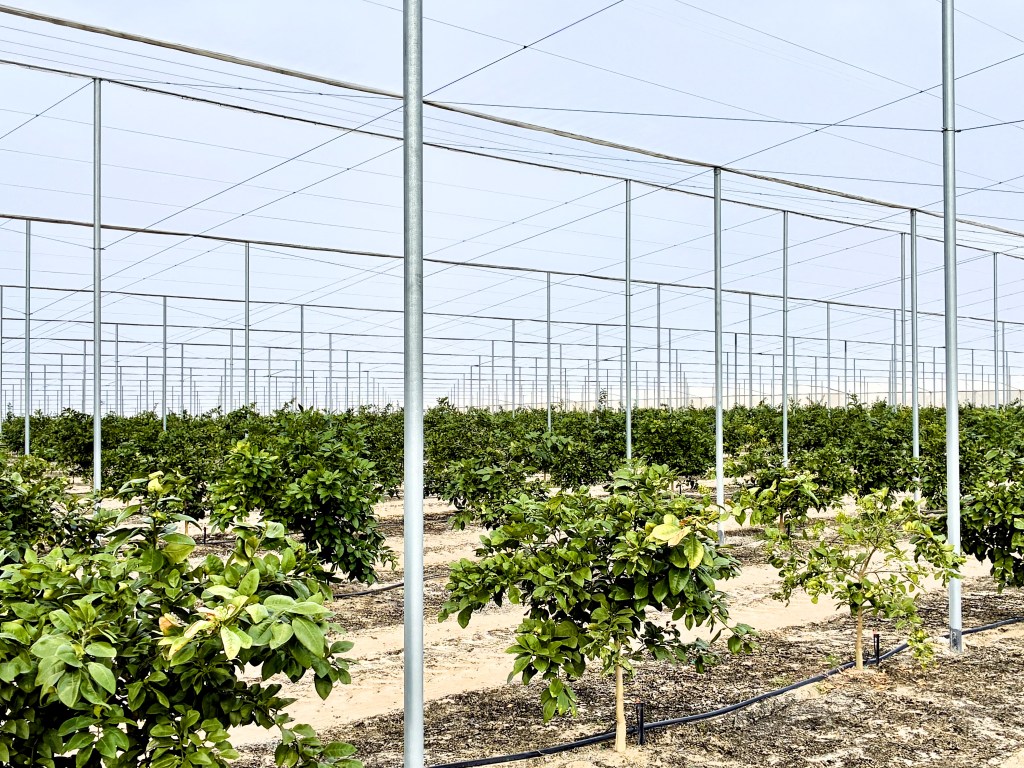
Our first stop was a few miles east of Fort Meade along U.S. 98. We visited the Dundee Citrus Growers Association (CGA) Citrus Under Protective Screen (CUPS) farm. I’ve actually driven by it several times over the past few years while heading to and from Tampa, Bartow, and Lakeland. It’s easy to spot along the old highway. It’s about 500 acres of screened farms with citrus growing inside – protected by the deadly psyllid insect. All of the sun gets in. All of the rain gets in. But the psyllids stay out. The screens were installed in 2022 and 2023, and the first trees were planted during the Fall of 2023. They grow red grapefruit under the Florida Rubies brand name.

Their grapefruits are available in many grocery stores and also online. They ship to anywhere in the U.S.A. and Canada.

Fun Facts: Their farm is at a high elevation for Central Florida – 215 feet above sea level. You can see it from aircraft flying above at cruising altitude. (Look for white landscape instead of tan.)

Next #TravelThursday – The Ag Tour returns to Highlands County to another citrus grove. I’ll introduce biochar to you. And then we’ll head into historic downtown Avon Park to enjoy a hot and delicious steak lunch. Travel & Food together. Let’s keep traveling together.

All rights reserved (c) 2026 Christopher M. Day, CountUp

Categories
Blogging Driving Geography History Travel

Sebring Historical Society

Welcome back to #TravelThursday. Anniversary Week continues here on my blog. Last week I wrote about my first visit to the historic Avon Park Depot Museum – operated by the Avon Park Historical Society. It was a disappointment, as it was unexpectedly closed due to COVID. (That was exactly 5 years ago this week.)

I immediately got back in my car on that cloudy and drizzly Wednesday morning in February of 2021, and I drove southward to downtown Sebring. I went to the city pier on Lake Jackson – a place I had visited before – to sightsee and determine my next move. (I had planned to visit the Military Sea Services Museum a few miles away, but they wouldn’t open until 12 Noon.)

As I was walking off the pier – I saw a sign nearby and a canopy over an entrance that read Sebring Historical Society. I was intrigued. I knew about the Avon Park Historical Society (because of their Internet presence), but I had no idea of the Sebring Historical Society. I walked up to the door to open it, and it was locked shut with no lights on inside even though they were supposed to be open based on the operating hours posted on the door. Well – the disappointment of the morning continued.

I wasn’t about to give up so quickly. I actually drove around the building, parked my car again, and noticed an entrance on the 2ND floor of that same building (from the parking lot on the hill). I walked-in, and within about 10 seconds I realized that I had unknowingly walked-in to the Sebring Public Library. #LOL

I looked around the library for a little while – pretending I was interested in what I was looking at. (I wasn’t.) After a few minutes of that I walked up to the front counter, and I inquired about the museum downstairs. The librarian actually called downstairs for me to find out if (or when) they would be open. I didn’t hear the other end of the conversation, but after the librarian got off the phone she told me that YES – they were open – but head for the “yellow house” (across the parking lot) instead, and walk-in. I thanked the librarian for going out of her way in doing that, and I headed for the “yellow house”.

A nice older woman greeted me at the front door as I walked-in, and she gave me an extensive guided tour of the historic house that less than 2 months earlier became a public museum after restoration. I loved every minute of her tour which lasted perhaps 45 minutes (if that). For the next 45 minutes we just chatted back-and-forth as if we knew each other for years. She lived much of her life in Miami-Dade County, and then she retired to Sebring where she served as a docent for the Sebring Historical Society. It sounded like an interesting plan. It sounded like a potential vision for my own future. She urged me to return to that first place that I tried to enter earlier but encountered a locked door. She said that I should talk to the guy that was working in there at that moment. He was a Director at the Sebring Historical Society. I did just that, and we talked for almost 90 minutes. (I also got to tour the premises which serves as a library of historical archives for the city and region.)

I was pretty sure what I was going to do once I moved up to Sebring a couple of years later (in 2023). I was going to be an active volunteer – physically serving and financially supporting the Sebring Historical Society.

I felt rejuvenated after that unexpected 3-hour experience. It was the highlight of my entire 5-day / 624-mile road-trip vacation. That was on Wednesday February 17TH 2021. This week marks my 5-year relationship with the Sebring Historical Society.

I kept my promise. I became a dues-paying member a month before I actually moved to Sebring in 2023. I immediately began actively participating and volunteering in various scheduled events. During most of 2024 I served as the Tuesday docent of that “yellow house” – now officially known as the Charles F. Weigle House Museum & Gift Shop. Later in 2024 I became the Social Media Director – in charge of our Facebook page. It’s now one of the most consistent and interactive Facebook pages in all of Highlands County. I was also nominated into our Board Of Directors where I’m currently serving a 3-year term.

Next #TravelThursday – I’ll write about our historic house that is the Charles F. Weigle House Museum & Gift Shop. Let’s keep traveling together.

All rights reserved (c) 2026 Christopher M. Day, CountUp