Categories
Blogging History Travel

The Hotel Jacaranda

Welcome back to #TravelThursday. A favorite place of mine in Avon Park Florida – aside from the historic Avon Park Depot Museum – is the historic Hotel Jacaranda – AKA “The Jac” – AKA “Queen Of The Ridge”.

Built between 1923 and 1926 along Main Street in the historic downtown district – it’s been operating continuously as a hotel with a restaurant for the past 98 years. It’s named for an estimated 150-year-old Jacaranda tree that had to be knocked-down and removed to make room for the building at its location at 19 East Main Street. The entire mile-long Main Street historic district (eastward from U.S. 27) is on the National Register Of Historic Places.

During the late-1920s and into the 1930s it housed visiting major and minor league baseball players who were training in the city. Babe Ruth stayed at the hotel, as did Clark Gable, George Burns and Gracie Allen, and other famous stars of sports and screen. During World War 2 it housed military pilots who were training at the nearby Army Airfield.

Since 1988 it’s been owned and operated by the South Florida State College Foundation. The college has classrooms within the building as well as offices and student dorm rooms. Culinary students train in the kitchen of the restaurant and create many of the meals that are served to its customers. I’ve enjoyed a half-dozen delicious meals at the restaurant, and I’ll continue to support them and enjoy the ambience of the historic hotel.

If there ever comes a time where I need to vacate my home for a night or two (power outage, no A.C. in the summertime, no water, etc.) – then I would definitely consider checking the availability of a room at The Jac. I would love to spend a night or two there.

Financial donations support continuous restoration of the hotel.

#CountUp & #TravelThursday is on Facebook.

Next #TravelThursday – Pioneer Daze is coming. I’ll tell you all about it. Let’s keep traveling together.

All rights reserved (c) 2024 Christopher M. Day, CountUp

Categories
Blogging History Travel

Tasmania Florida

Welcome back to #TravelThursday. Last week I wrote about the historic Avon Park Depot Museum – operated by the Avon Park Historical Society. It’s located about 4½ miles from my neighborhood. On a recent visit a friendly docent greeted me, and we had a nice conversation about local history – not just of Avon Park, but also of the entirety of Highlands County and beyond. Truly I could have spent several hours in conversation with him.

He told me about Tasmania (Florida) and Fisheating Creek. That led me to do some historical research on the ghost town and the natural free-flowing stream that runs alongside it.

So Tasmania is actually located in western Glades County (our neighbor to the south). It’s about 10 miles west of the small community of Palmdale, and about 4 miles south of the Highlands County line. What remains of Tasmania are foundations and a few farm buildings along what is now Tasmania Road, or Glades County Road 731. (That zigzagging road also enters Highlands County.)

Tasmania was established during the late-1880s, and it got its name in 1916. The small settlement along Fisheating Creek (its original name) was mostly abandoned during the Great Depression of the 1930s when it was bypassed by the railroad to the east (along what is now U.S. 27).

Fisheating Creek begins in the hills of southwestern Highlands County, and it flows downhill for about 50 miles southward into Glades County and then eastward into Lake Okeechobee providing the big lake with about 9% of its water (the second-largest natural source of water after the Kissimmee River). There’s actually a gap in the 30-foot-high Herbert Hoover Dike that surrounds Lake Okeechobee where Fisheating Creek flows freely through to the lake on its west side. (The dike parallels the Creek at its mouth.)

I’m glad I had that conversation with that docent on that day in Avon Park. I got to learn all about Tasmania and Fisheating Creek. I’ve driven over the Creek about 60 times over the past 18 months via U.S. 27. Now when I drive over it – I’ll be thinking about everything that I’ve learned about it from source to mouth – from swampland past settlement to lake.

As a fellow historical museum docent – I’m encouraged to know that my visitors are learning about the local area from me, and then they are leaving and telling their family and friends about their experience. They may also be doing historical research of their own. That’s a great way to preserve, protect, and promote history around us.

Florida Fish And Wildlife Conservation (FWC) Commission –
Fisheating Creek Wildlife Management Area

#CountUp & #TravelThursday is on Facebook.

Next #TravelThursday – we take a trip out west to Texas. Let’s keep traveling together.

All rights reserved (c) 2024 Christopher M. Day, CountUp

Categories
Blogging History Travel

Avon Park Depot Museum

Welcome back to #TravelThursday. 113 weeks ago I wrote all about my first visit (which was really my second visit) to the historic Avon Park Depot Museum – operated by the Avon Park Historical Society. It’s located about 4½ miles from my neighborhood. I visited the museum on a previous trip to the area in February 2021. I arrived at the museum. I took a couple of exterior photos. I walked-up to the front door, and it was locked shut. #COVID

What a disappointment. I immediately returned southward to Sebring. That disappointment actually led me to a big “reveal” with the Sebring Historical Society that began my relationship with them.

Meanwhile I’ve been visiting the Depot Museum in downtown Avon Park on a fairly regular basis. My friend Elaine is the Museum Curator, and she frequently updates the museum with new displays – both temporary and permanent. It’s a very nice museum to visit set in a historic train depot, and the trains keep on rolling by. (They just don’t stop.)

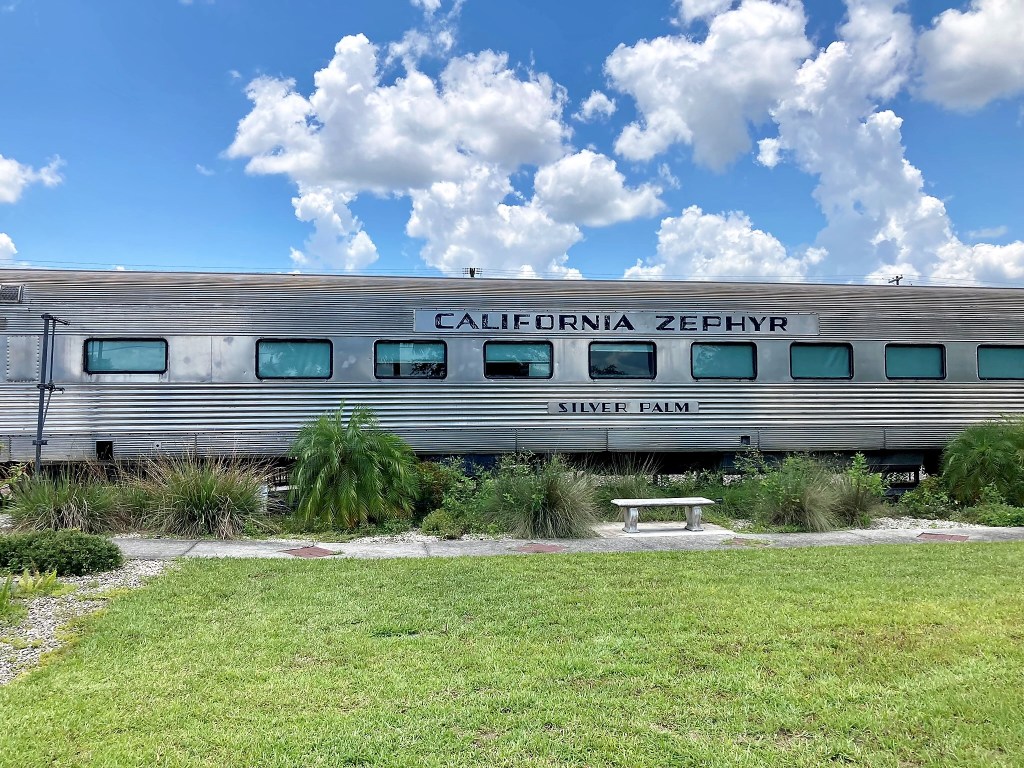
On some days you may even be able to get a bonus exclusive behind-the-scenes tour inside this railroad dining car (acquired in 1986) that last saw action as part of Amtrak’s Auto Train. It’s now used for special catered dining events by groups of 16 to 36 (by reservation only).

The museum is a traditional historical museum for the city of Avon Park. You can easily spend an hour or two checking it all out and allowing the docent and curator to share history with you. It’s currently open from 10 AM to 3 PM on Wednesdays, Thursdays, and Fridays. It’s located at 3 North Museum Avenue right after the first set of railroad tracks if you’re driving east on Main Street from U.S. 27. Make a left at Museum Avenue, and you’ll see the museum and the dining car on the left-hand side.

The docent on duty at the museum during my visit last month told me all about Tasmania Florida and Fisheating Creek. That led me to do some historical research on the ghost town and the natural free-flowing stream that runs alongside it. I’ll share what I learned next – #TravelThursday. Let’s keep traveling together.

All rights reserved (c) 2024 Christopher M. Day, CountUp
Categories
Blogging Commerce Driving Food Geography History Home Shopping Travel

St. Johns River Cruise

Welcome back to #TravelThursday. Last Thursday me and 42 of my Sebring Historical Society friends met at our Charles Frederick Weigle House Museum early in the morning, and we boarded a chartered bus – courtesy of Small World. We departed for historic downtown Sanford Florida – 108 miles north of Sebring.

We arrived 2½ hours later, and we immediately boarded the 105-foot Rivership Barbara-Lee – courtesy of the St. Johns Rivership Co. We were treated to an interactive comedy wedding complete with singalongs and dancing on the dancefloor. The show essentially started as soon as we got off the bus, and it kept on going intermittently until the ship returned to its dock 3½ hours later.

Our multi-course lunch was pretty good. Nothing spectacular, but better than a typical lunch for me. I had the Prime Rib (cooked perfectly medium-well) served with mashed potatoes and green beans. A side salad and rolls were served beforehand, and delicious dessert (red velvet cake) was served afterward.

Our trek along the St. Johns River actually started dockside on the south shore of 9,406-acre Lake Monroe. We continued WNW – past the Central Florida Zoo & Botanical Gardens – off the lake and onto the river proper – underneath both I-4 and U.S. 17 / U.S. 92.

Crossing-over from Seminole County into Volusia County – we went about 7 miles up the river, and then we went around an island and came back southward. It was a nice slow cruise up and down the lazy river on a mostly sunny and hot afternoon; although, it felt cooler (with a nice refreshing breeze) outside – especially on the upper decks of the rivership.

On our way to and from the dock – we caught a glimpse of the vibrant historic downtown district of Sanford. I’d like to walk around and check it out on my own on a future daytrip to (or through) the area. I definitely want to visit the Zoo. I think this field trip was my very first visit ever to the area northeast of Orlando. There’s a lot to see and visit up there !

Fun Facts: We avoided I-4 between Kissimmee and Sanford by taking the “Eastern Beltway” (Florida State Road 417) northward and the “Western Beltway” (Florida State Road 429) southward. Both routes combined form a 108-mile ring around Orlando. On this field trip we traversed 7 counties – Highlands, Polk, Osceola, Orange, Seminole, Volusia, and Lake.

As we returned to our museum in Sebring – our Director announced our next field trip in a little over 3 months to Clewiston to visit an Indian Museum and to Okeechobee for a big Lunch. I’m looking forward to it !

Next #TravelThursday – I’ll tell you all about Frostproof Florida. Let’s keep traveling together.

All rights reserved (c) 2024 Christopher M. Day, CountUp