Categories
Animals Blogging Driving Football Geography Nature Photography Sports Television Travel Weather

My American Splendor Cruise – Part 6

Welcome back to #TravelThursday. My journey continues in Grand Rivers Kentucky on Sunday October 04TH 2026. I actually stayed on the ship in my stateroom all morning to watch a rare Sunday morning NFL game on TV with my Washington Commanders playing the Indianapolis Colts in London England. (My Commanders lost.)

Skies eventually cleared from the dreariness of the previous day. The cold front had swept the region, and instead of 80s and 90s we had 60s and 70s with much lower humidity. It finally felt like Autumn in the Tennessee River Valley.

In the afternoon I headed ashore to catch my excursion to the Land Between The Lakes National Recreation Area. This was a fun 3-hour-plus tour – half on the bus – and half walking around. Our only stop lasted for about an hour at the Woodlands Nature Station. It was part Visitor’s Center / Museum / Gift Shop / Aquarium / Herpetarium (inside), and part wildlife preserve (outside). The preserve featured wild animals that were injured and could no longer survive out in the wild, so they were being taken care of there.

Fun Facts: The Land Between The Lakes National Recreation Area is a 171,280-acre protected peninsula between the Tennessee River (Kentucky Lake) to the west and the Cumberland River (Lake Barkley) to the east where they run closely parallel to each other. President John F. Kennedy designated it as a National Recreation Area in 1963. The United States Forest Service protects the area. An estimated 2 million visitors spend time there each year. A small 3-mile portion of the area extends south of the state line into Tennessee.

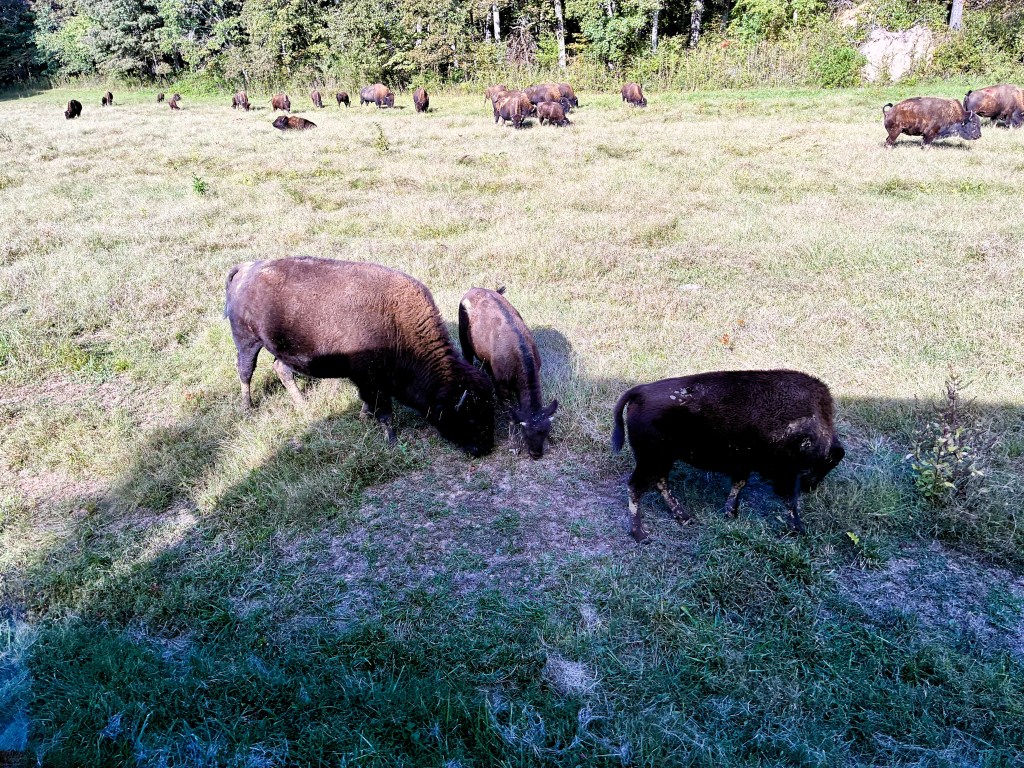
The second part of our excursion was a slow drive in our #ACL luxury coach through the fenced and gated 700-acre Elk & Bison Prairie. We saw a few elk relaxing under the trees in the shade, and one actually emerged from the trees and slowly crossed over the road right in front of us. We saw dozens of bison grazing on the grass – mostly in one big group. At one point a traffic jam formed because some of the bison decided that the middle of the road was the perfect place to be.
I liked this shore excursion. It was 1 of 7 that I went on during my cruise. Next week I’ll rate my 7 shore excursions from most-favorite to least-favorite.

Tomorrow on Facebook (#FollowUpFriday) I’ll write about a funny man by the name of Paul Aldrich who sang for us and made us laugh on that Sunday night, and next #TravelThursday I’ll write about Nashville, and I’ll rate my shore excursions. Let’s keep traveling together.

All rights reserved (c) 2026 Christopher M. Day, CountUp

Categories
Blogging History Travel

Tasmania Florida

Welcome back to #TravelThursday. Last week I wrote about the historic Avon Park Depot Museum – operated by the Avon Park Historical Society. It’s located about 4½ miles from my neighborhood. On a recent visit a friendly docent greeted me, and we had a nice conversation about local history – not just of Avon Park, but also of the entirety of Highlands County and beyond. Truly I could have spent several hours in conversation with him.

He told me about Tasmania (Florida) and Fisheating Creek. That led me to do some historical research on the ghost town and the natural free-flowing stream that runs alongside it.

So Tasmania is actually located in western Glades County (our neighbor to the south). It’s about 10 miles west of the small community of Palmdale, and about 4 miles south of the Highlands County line. What remains of Tasmania are foundations and a few farm buildings along what is now Tasmania Road, or Glades County Road 731. (That zigzagging road also enters Highlands County.)

Tasmania was established during the late-1880s, and it got its name in 1916. The small settlement along Fisheating Creek (its original name) was mostly abandoned during the Great Depression of the 1930s when it was bypassed by the railroad to the east (along what is now U.S. 27).

Fisheating Creek begins in the hills of southwestern Highlands County, and it flows downhill for about 50 miles southward into Glades County and then eastward into Lake Okeechobee providing the big lake with about 9% of its water (the second-largest natural source of water after the Kissimmee River). There’s actually a gap in the 30-foot-high Herbert Hoover Dike that surrounds Lake Okeechobee where Fisheating Creek flows freely through to the lake on its west side. (The dike parallels the Creek at its mouth.)

I’m glad I had that conversation with that docent on that day in Avon Park. I got to learn all about Tasmania and Fisheating Creek. I’ve driven over the Creek about 60 times over the past 18 months via U.S. 27. Now when I drive over it – I’ll be thinking about everything that I’ve learned about it from source to mouth – from swampland past settlement to lake.

As a fellow historical museum docent – I’m encouraged to know that my visitors are learning about the local area from me, and then they are leaving and telling their family and friends about their experience. They may also be doing historical research of their own. That’s a great way to preserve, protect, and promote history around us.

Florida Fish And Wildlife Conservation (FWC) Commission –
Fisheating Creek Wildlife Management Area

#CountUp & #TravelThursday is on Facebook.

Next #TravelThursday – we take a trip out west to Texas. Let’s keep traveling together.

All rights reserved (c) 2024 Christopher M. Day, CountUp