Categories
Animals Blogging Bugs Driving Geography History Home Nature Photography Travel

Highlands Hammock State Park Or Bust

Welcome back to #TravelThursday. Last week I began writing about my trip out to the 9,000+ acre Highlands Hammock State Park here in the Sebring Florida area (about 10 miles from home).

My plan for the morning at the park was set, so it was time to go !

First setback – the 11 AM tram tour was inexplicably sold out, and I didn’t want to stick around for an additional 1 PM tour. The Civilian Conservation Corps (CCC) Museum was closed until 10 AM. So my next move was to drive the 3+ mile “Loop Drive” through the park.

“Loop Drive” is a one-way counter-clockwise paved road with room for one vehicle to traverse with a bike lane running alongside it. The speed limits is 15 or 20 MPH, and you don’t want to drive any faster than that because the whole idea of the road is to see things as you drive slowly by. You also want to stay safe and not endanger any wildlife along the way, or bicyclists, or visitors walking around. Nature owns the park, so it should be respected.

Once on “Loop Drive” there are 8 walking trails where you can park your vehicle, get out, and walk on. Most are between 1,400 and 3,000 feet in length (a quarter-mile to a half-mile). Some of the trails meet each other, so you can go on a longer walk by combining adjoining trails.

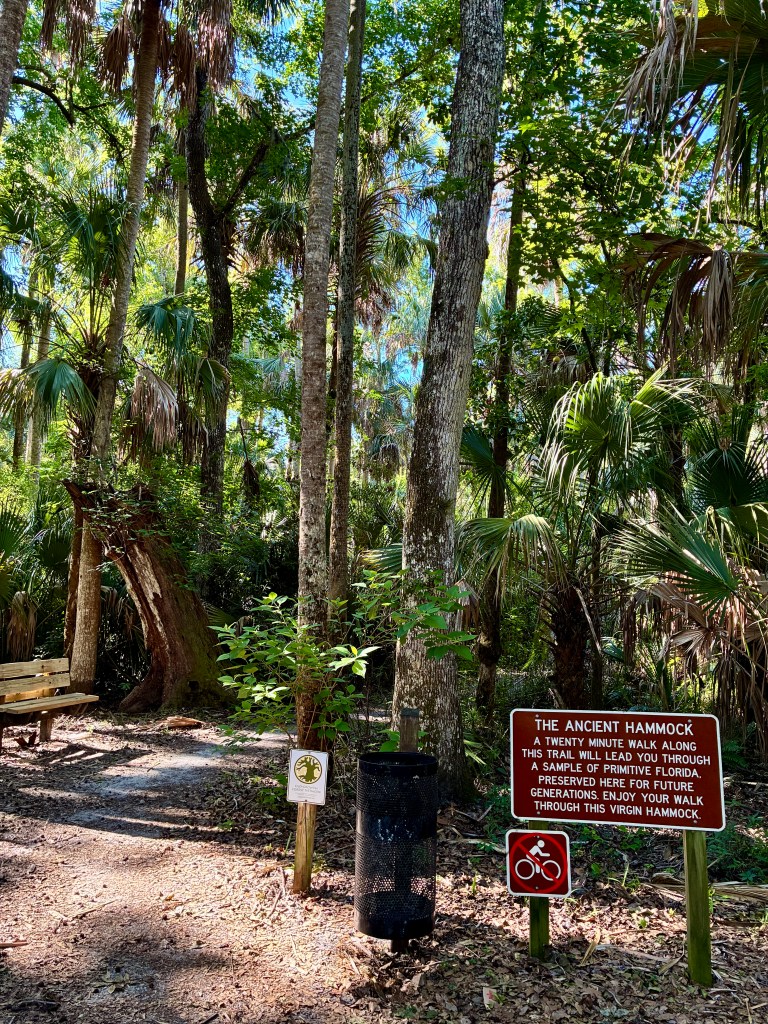
I’ve been on most of the trails previously. One of the last ones along the road is the Ancient Hammock Trail – at 3,005 feet in length. It’s the longest trail in the park. It’s connected to the Sweetgum Trail (1,445 feet). It’s in the oldest part of the park, and it features towering cabbage palms and live oaks – some of which may be over 1,000 years old. There’s also an old CCC bridge near the top of the trail. I selected the trail to be the one that I would get out of my car for, and walk, and explore nature and hopefully not too much wildlife. I didn’t want to encounter any wild creatures that were bigger than me.

But that’s exactly what happened. About two-thirds of the way around the trail – out of nowhere – a large wild animal crossed in front of me from left to right – running quickly like it was being chased by an even bigger creature. It was either a Florida Panther, a coyote, or a deer. I didn’t get a good look at it since it was a blur while running, but I saw a tan color all over. That was the only excitement on the trail. Other than that – the bugs were surely out. It wasn’t too bad though. I imagine that the park is saturated with bugs during our 4-month rainy season from June through September.

I got back in my car, and I headed back to the main Camp Store / CCC Museum area. What did I see upon returning to that area ? I saw 2 big yellow Highlands County School District buses !

You know what that means. I’ll tell you all about it – next – #TravelThursday. Let’s keep traveling together.

All rights reserved (c) 2026 Christopher M. Day, CountUp
Categories
Blogging Bugs Driving Food Geography Home Nature Travel

Ag Tour

Welcome back to #TravelThursday. Last year a couple of my friends at the Sebring Historical Society told me all about an “ag tour” that they went on. It sounded very interesting. They boarded a bus early in the morning, and they went on a guided tour of various agricultural sites around the region. In the middle of it all – a big steak lunch. I was intrigued. Travel & Food together. Two of my favorite pastimes.

The tours are limited to the winter season – January, February, and March – on the last Thursday of each month. They start at 8 AM and end at 5 PM. They are hosted by UF IFAS Extension – which stands for University Of Florida Institute Of Food And Agricultural Sciences. They have Extension offices in all 67 of Florida’s counties. (I’m in Highlands County.)

I didn’t get a chance to sign-up for any of the remaining tours last season (2025), and then I pretty much forgot about them during the “off-season”.

Last month at our Sebring Historical Society board meeting we were discussing an upcoming event when one of our board members pointed out that the date of that event conflicts with an “ag tour”.

Once he said that – bells started ringing in my mind. I went home that night and began looking up the ag tours to get more information on them. One was coming up on the last Thursday of February. I read the itinerary. I was determined to be on it. Less than a week later I actually drove to the Extension Office (for the first time ever) – 10 miles away from home – to sign-up for it and pay for it ($100).

Thursday February 26TH 2026 was the date of the tour, and I arrived back at the Extension office (formally it’s the Bert J. Harris, Jr. Agricultural Center Highlands County). I arrived about 40 minutes before the start of the tour. Apparently – that wasn’t early enough, as there were already several dozen people there before me. I checked-in, I retrieved my big bag of goodies / freebies from the various sponsors of the tour, and I got on the 56-passenger luxury coach.

We departed promptly at 8 AM on a mostly cloudy and chilly morning. We took an unusual route to our first of six stops – perhaps by design. We headed south briefly along U.S. 27 before turning west into Hardee County, and then north into Polk County. It was all two-lane backroads (after U.S. 27) – through the countryside – with farmlands on both sides. Many of the farms didn’t look too good after numerous frosts and freezes. Our UF IFAS hostess narrated and answered questions along the way. She was very knowledgeable and informative.

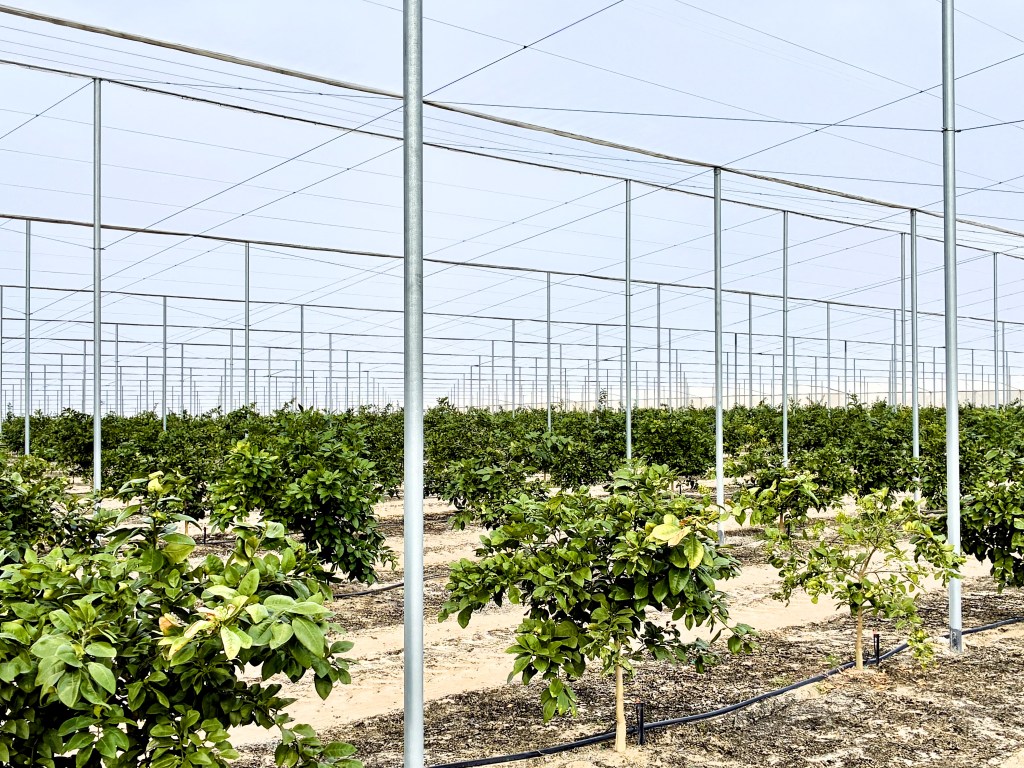
Our first stop was a few miles east of Fort Meade along U.S. 98. We visited the Dundee Citrus Growers Association (CGA) Citrus Under Protective Screen (CUPS) farm. I’ve actually driven by it several times over the past few years while heading to and from Tampa, Bartow, and Lakeland. It’s easy to spot along the old highway. It’s about 500 acres of screened farms with citrus growing inside – protected by the deadly psyllid insect. All of the sun gets in. All of the rain gets in. But the psyllids stay out. The screens were installed in 2022 and 2023, and the first trees were planted during the Fall of 2023. They grow red grapefruit under the Florida Rubies brand name.

Their grapefruits are available in many grocery stores and also online. They ship to anywhere in the U.S.A. and Canada.

Fun Facts: Their farm is at a high elevation for Central Florida – 215 feet above sea level. You can see it from aircraft flying above at cruising altitude. (Look for white landscape instead of tan.)

Next #TravelThursday – The Ag Tour returns to Highlands County to another citrus grove. I’ll introduce biochar to you. And then we’ll head into historic downtown Avon Park to enjoy a hot and delicious steak lunch. Travel & Food together. Let’s keep traveling together.

All rights reserved (c) 2026 Christopher M. Day, CountUp
Categories
Blogging Bugs Driving Geography History Home Military Nature Travel

Florida Medal Of Honor Memorial

Welcome back to #TravelThursday. This week I’m writing about my first-time visit a little over 3 weeks ago to our newest museum right here in my hometown of Sebring Florida. It’s the Florida Medal Of Honor Memorial.

Their Mission is “to honor and preserve the legacy of Florida Medal of Honor recipients through education, leadership, and inspiring displays, ensuring their courage and sacrifice are never forgotten.”

24 Medal of Honor recipients are Floridians – including our very own Major Thomas “Mickey” McGuire Jr. (1920-1945; Sebring High School Class of 1938). Check out his displays inside the Visitors Center.

What a wonderful Memorial (outside) and a beautiful Visitors Center (inside). It’s a fantastic addition to downtown Sebring, and as a Director of a neighboring historical museum – I welcome them to the family. I went home that night, and the next day I wrote them a check to cover a 5-year membership for myself. I want to be part of their growth and evolution. I want to support them in any way that I can.

Fun Fact: Surrounding the museum and the memorial are mostly (90%) native Florida plants – over 650 of them – including over 40 species. The plants were selected based on their colors, textures, and interactions with wildlife – attracting and supporting local butterflies, birds, and beneficial insects.

They are located at the corner of South Commerce and South Eucalyptus in downtown Sebring – 0.4 miles from our Circle – right next to the Highlands County Government Center. They are open 5 days a week – Tuesdays to Saturdays – from 10 AM to 4 PM. In addition to their official web site (hyperlinked above) – you can check them out on both Facebook and X.

Mama Told Me Not To Come, but The Show Must Go On, so we’ll Shambala An Old Fashioned Love Song Out In The Country – at least this One time, so that there is Joy To The World for the Black And White – next – #TravelThursday. Let’s keep traveling together.

All rights reserved (c) 2025 Christopher M. Day, CountUp

Categories
Animals Blogging Bugs Driving Geography Holidays Home Nature Travel

Archbold Biological Station

Welcome back to #TravelThursday. There’s a large tract of land directly to the north of my neighborhood that’s unspoiled raw Florida scrub. I have a great view of it out my second-floor side and front windows. I bet it looks exactly the same now as it did 25 – even 50 years ago – probably even more than that. It’s what my neighborhood probably looked like before 1985 – when the land was cleared, and construction began. I love living on the other side of our perimeter fence from that scrub. I often stare at it for minutes – watching the nature and the wildlife that prospers there. It’s like living right next door to a nature preserve. I hope it stays like that for the rest of my life.

A couple of Wednesdays ago on New Year’s Day Morning I had the opportunity to finally visit the Archbold Biological Station 30 miles away down in the southern end of my home county – Highlands. It’s about a mile-and-a-half west of U.S. 27, so I’ve driven by it dozens of times. It was my first time there. For several years I thought that it was closed to the general public, but then I realized that they actually have a small Learning Center there along with public nature trails nearby.

They hosted a “First Day Hike” along some of the private (unmarked) nature trails (for research use only). I figured I’d be 1 of 5 visitors to participate early on the first morning of 2025, but surprisingly there were at least 25 of us (several families with children) along for the hike through the protected Florida scrub. Our tour guide pointed out various insects, birds, animal tracks, and vegetation along the sandy trails. We walked through prescribed burn areas, as well as non-burn areas.

Our part of South-Central Florida is the oldest land south of the Florida Panhandle. A long time ago – back when sea levels were as much as 150 feet higher than they are now – only this area – the narrow high spine of Florida – was above water – as a series of islands – resembling today’s Florida Keys. Everything to the south, east, and west was the sea. The sand that dominates our landscape – visible from space – is ancient sand leftover from that era. Some of our vegetation can be found nowhere else in Florida. I guess I don’t need to explain how Highlands County got its name.

It was a fun “First Day Hike” through the scrub. We walked about a mile-and-a-half total during the informative 2-hour tour. It was a great way to start the new year in an educational and physical way.

Next #TravelThursday – It’s a change-of-pace. I’ll do a little bit of reminiscing. I’ll write about me and my family getting ready to make a move 50 years ago. Let’s keep traveling together.

All rights reserved (c) 2025 Christopher M. Day, CountUp